kahfuymllw vlkivusats Download DeDisplay Fonts Family From Ingo

Download DeDisplay Fonts Family From Ingo
Download DeDisplay Fonts Family From Ingo Download DeDisplay Fonts Family From IngoDownload DeDisplay Fonts Family From Ingo


A type designed in a grid, like on display panels


Type is not only printed. There were always and still are a number of forms of type versions which function completely differently. Even very early in the history of script there were attempts to combine a few single elements into the diverse forms of individual characters and also efforts to construct the forms of letters within a geometric grid system. The “instructions” of Albrecht Dürer are probably most well-known.


But although designers of past centuries assumed the ideal to basically be an artist’s handwritten script, the idea which developed in the course of mechanization was to “build” characters in a building block system only by stringing together one basic element — the so-called grid type was discovered, represented most commonly today by »pixel types.« But even before computers, there were display systems which presented types with the help of a mechanical grid display, like the display panels in public transportation (bus, train) or at airports and train stations.


In a streetcar, I met up with a modern variation of this display which reveals the name of each tram stop as it is approached. This system was based on a customary coarse square grid, but the individual squares were also divided again diagonally in four triangles.


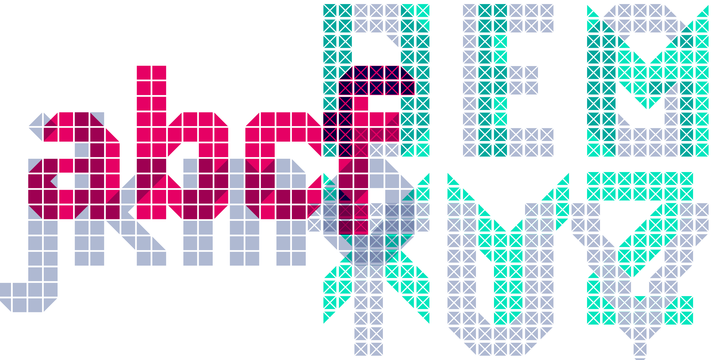
In this way it is possible to display slants and to simulate round forms more accurately as with only squares. The displayed characters still aren’t comparable to a decent typeface — on the contrary, the lower case letters are surprisingly ugly — but they form a much more legible type than that of ordinary [quadrate] grid types.


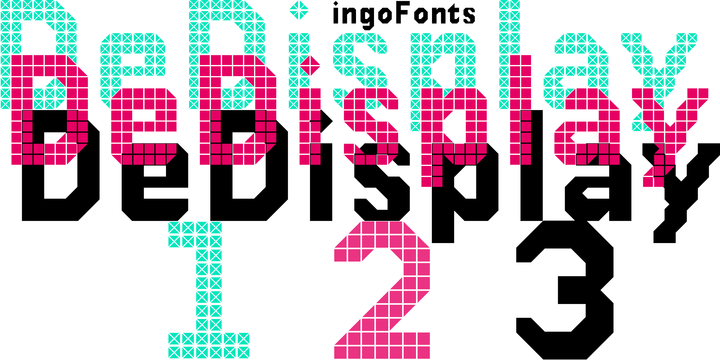
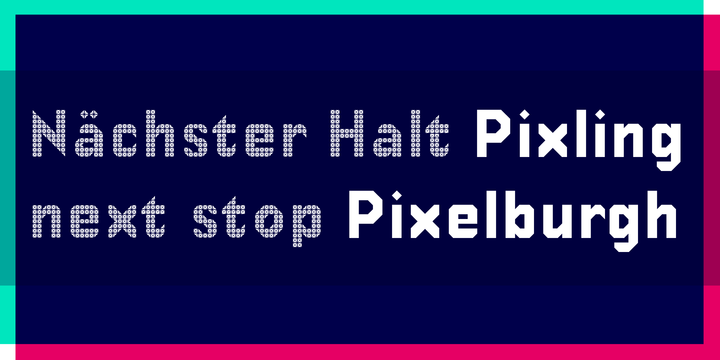
DeDisplay from ingoFonts is this kind of type, constructed from tiny triangles which are in turn grouped in small squares. The stem widths are formed by two squares; the height of upper case characters is 10, the x-height 7 squares.


DeDisplay is available in three versions: DeDisplay 1 is the complex original with spaces between the triangles, DeDisplay 2 forgoes dividing the triangles and thus appears somewhat darker or “bold,” and DeDisplay 3 is to some extent the “black” and doesn’t even include spaces between the individual squares.


Download DeDisplay Fonts Family From IngoDownload NowView Gallery


Popular posts from this blog

Download Hamis Font Family From Fo Da

Download Now Server 1 Download Now Server 3 Download Now Server 2 Hamis is a display font of a single weight " Regular ", ideally suited for advertising and packaging, festive occasions, editorial and publishing, logo, branding and creative industries, posters and billboards as well as web and screen design. Hamis provides advanced typographical support with features such as ligatures, case-sensitive forms, fractions, super and subscript characters, and stylistic alternates. It comes with a complete range of figure set options – oldstyle and lining figures, each in tabular and proportional widths. Download Hamis Font Family From Fo Da

Download Guile Font Family From Bunny Dojo

Download Now Server 1 Download Now Server 3 Download Now Server 2 A timeless and mighty sans-serif, Guile's chiseled forms make the font ideal for reaching into history, while its minimalism and balance are fit for propelling into the future. Guile voraciously absorbs and enhances the style of its surroundings. In sports, it's a true team player, from the jerseys to the on-air presentation. In film, it's a blockbuster star, from the title treatment to the billing block. Download Guile Font Family From Bunny Dojo

Calvino fonts from Zetafonts - (avesk)

Download Now Server 1 Download Now Server 3 Download Now Server 2 In designing the  Calvino  typeface family  Andrea Tartarelli  set himself the challenge to follow the principles expressed by the Italian writer  Italo Calvino   in his masterpiece  Six memos for the next millenium .  Exactitude  and  visibility  are translated typographically through the reference to sixteen century garalde typography and its controlled, highly legible letterforms. To balance this formal rigour,  lightness  and  quickness  were added by letting the design be inspired by the calligraphic hand, following the lesson of Gudrun Zapf. The idea of  multiplicity was kept central, developing  Calvino  in a range of weights encompassing both display and text use cases, and then expanding the design space with the inclusion of a display sub-family,  Calvino Grande , to provide user...